Some of Singapore’s most meaningful care is happening in living rooms. This is what it looks like when care travels to the people who need it most.
At 6:45am on a Tuesday, Dr. Han Yang is checking the contents of a black medical bag. Stethoscope. Thermometer. A small cold-chain container holding single-use vaccine vials. A paediatric pulse oximeter. A second stethoscope, in case the first fails. He runs through the list twice, closes the bag, and leaves the office.
His first patient of the day is eleven weeks old.
By nine o’clock, Dr. Han Yang will be sitting on the floor of a living room in Ang Mo Kio, next to a first-time mother, explaining to her that her daughter will cry for about seven seconds and then forget. He will be right. Over the past year, he has come to understand something most clinicians rarely get to see — what it looks like when a baby is vaccinated in the place she feels safest, in the arms of a parent who isn’t worrying about parking.
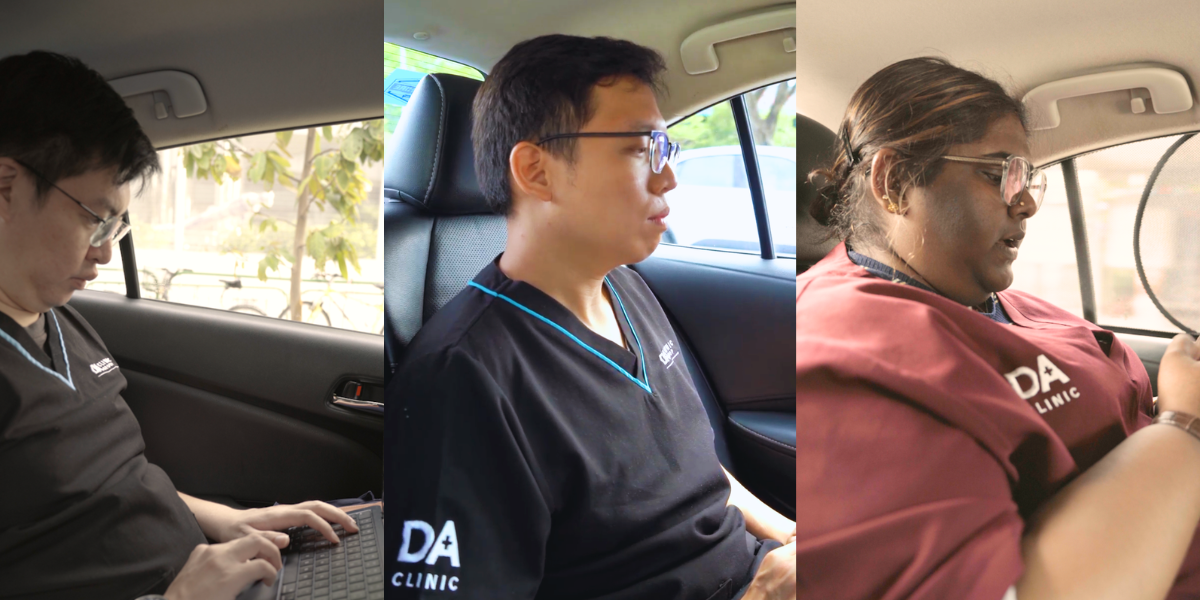
By sundown, he and a small team of colleagues will have visited several homes across the island. Some of those families had a newborn too young to bring out. Some had a parent who could no longer leave the house. All of them, for one reason or another, needed care to come to them, comfortably.
◆ ◆ ◆
This is what one corner of Singapore’s healthcare looks like in 2026.
This is not about new hospitals or new technology. It is about something simpler: the moments when getting to a clinic is harder than it should be, and what becomes possible when a doctor or nurse arrives at the door instead.
The patients vary. A new mother recovering from a difficult delivery, who would rather not bring an infant onto an MRT in flu season. A working son whose elderly father has not been seen by a doctor in three years. A retiree learning to live with a new stoma, whose wife is changing the dressing for the first time. A patient on a course of IV antibiotics that doesn’t fit around a working clinic schedule. An uncle who needs a wound redressed twice a week and finds the trip to the polyclinic harder than the wound itself. A grandmother who can manage the lift but not the bus that comes after it. A father quietly arranging his Lasting Power of Attorney, who would rather have that conversation in his own living room than in a waiting area.
Singapore is one of the fastest-ageing societies in Asia. This year, in 2026, it is projected to become a “super-aged” society — the threshold at which one in five residents is sixty-five or older. By 2030, that figure rises to nearly one in four citizens, according to official Singstat projections. For more older Singaporeans every year, the trip to the clinic is not a difficult one. It is the part that doesn’t happen.
National policy is leaning into the same insight. Healthier SG, launched in July 2023, has placed preventive care — screenings, vaccinations, a long-term relationship with a family doctor — at the centre of how Singapore looks after its people. Age Well SG, launched in November of the same year and backed by S$3.5 billion over the decade, is built on a complementary idea: that for many seniors, the most useful place for care to be is close to home.
What that looks like, on a Tuesday morning, is Dr. Han Yang at someone’s door.
◆ ◆ ◆
Dr. Hong Rong has been practising medicine in Singapore for most of his adult life. For the last three years, he has spent much of his clinical time in other people’s living rooms.
“The clinic is a wonderful place,” he says. “For most patients, most of the time, it’s exactly where care should happen. But for some patients — at certain moments in their lives — getting there is the part that’s hard. And when getting there is the part that’s hard, sometimes the visit just doesn’t happen.”
He tells the story of a recent patient — a retired civil servant in his late eighties. His daughter had been gently asking him to see a doctor for some time. Each time, he had said the same thing. I’m fine. Eventually, the family asked whether someone could come to him instead.
When Dr. Hong Rong rang his doorbell, the patient took off his glasses, sat down across from him, and suggested a cup of kopi. The clinical examination took fifteen minutes. The conversation took the better part of an hour.
“At home, you have time,” Dr. Hong Rong says. “The patient has time. The family has time. You see the photographs on the wall. You see what they ate for breakfast. You learn things about a patient’s life in twenty minutes that you might not learn in a year of clinic visits. And those things matter for the care.”
◆ ◆ ◆
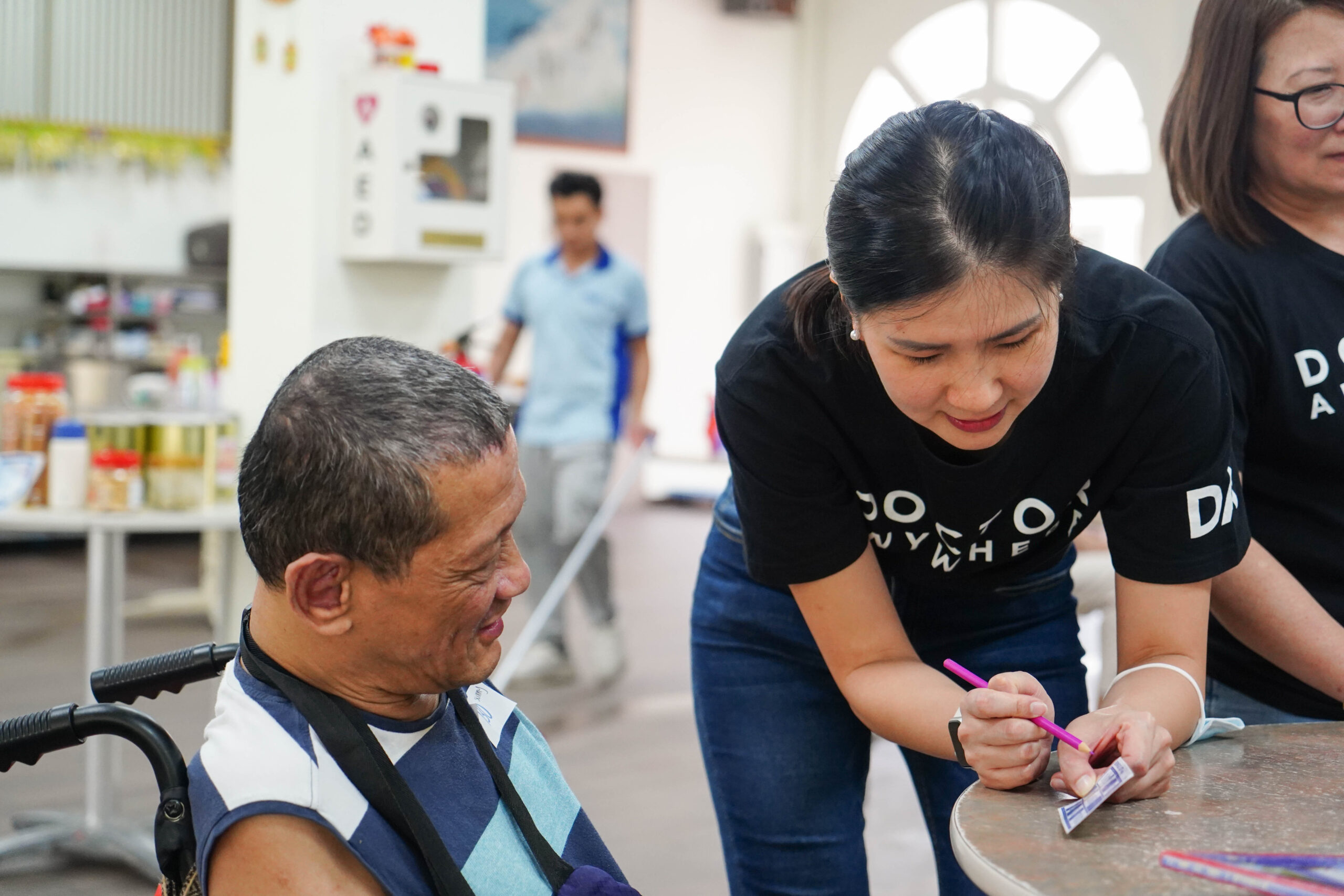
Nurse Sarah works alongside Dr. Han Yang and Dr. Hong Rong, often as part of the same team. She has done home blood draws for patients whose immune systems can’t risk a waiting room. She has held a grandmother’s hand in Queenstown while her daughter learned how to change a post-operative dressing. She has sat with a young couple in Sengkang on the morning of an IVF injection, walking the wife through the timing and the angle, and staying long enough to make sure the second dose, two evenings later, would feel less like a leap.
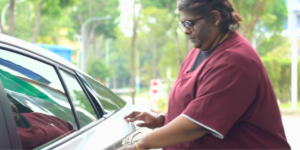
Her professional geography is unlike that of most nurses her age. She knows the living rooms of Singapore as well as she knows the wards she trained on.
“The rooms teach you,” she says. “In a clinic, everyone is on your territory. You’re the one in the uniform. At home, I’m the guest. The patient is the host. It changes what the care feels like — for them, and honestly, for me too.”
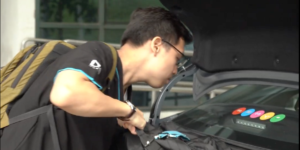
The care professionals were always willing. What had been missing was the connective tissue — the scheduling, the coordination, the cold-chain logistics, the ease of moving between several homes in a day without losing an hour to every drive.
Doctor Anywhere, a Singapore-based health technology company, has spent the last several years building that connective tissue. The Doctor House Call service, in partnership with mobility specialist Lumens, allows patients and families to book a doctor, nurse, or care team to their home through the Doctor Anywhere app or website— for paediatric and adult vaccinations, senior home care in the spirit of Age Well SG, and post-hospital recovery support.
“For patients, what changes is simple — faster access to care, greater comfort, and less stress,” says Ivin Yew, Chief Executive Officer, General Health Services at Doctor Anywhere. “Whether it’s an elderly patient who finds travel difficult, or a family with a sick child at home, having care come to them makes healthcare feel more reassuring. That matters more and more as Singapore looks to keep care close to where people actually live.”
◆ ◆ ◆
By late afternoon, Dr. Han Yang is in a sixth-floor flat in Tampines. The patient is eighty-seven. The room smells faintly of pandan. A photograph on the wall shows the patient’s late wife at what appears to be a wedding. Dr. Han Yang listens for a long time before he reaches for his stethoscope.
When he leaves, the patient’s daughter walks him to the lift.
“Thank you for coming,” she says. “It meant a lot to him.”
Dr. Han Yang nods. He packs his bag — stethoscope, thermometer, the things he will need for the next patient — and begins to walk down the corridor. The evening light is starting to turn the wall tiles gold.
His next patient is eleven weeks old.
“Care That Comes To You: is a three-episode film series by Doctor Anywhere. Episode 1: Dr. Han Yang. Episode 2: Dr. Hong Rong. Episode 3: Nurse Sarah. Streaming soon on YouTube.
Learn more and book our services here: Doctor House Call.